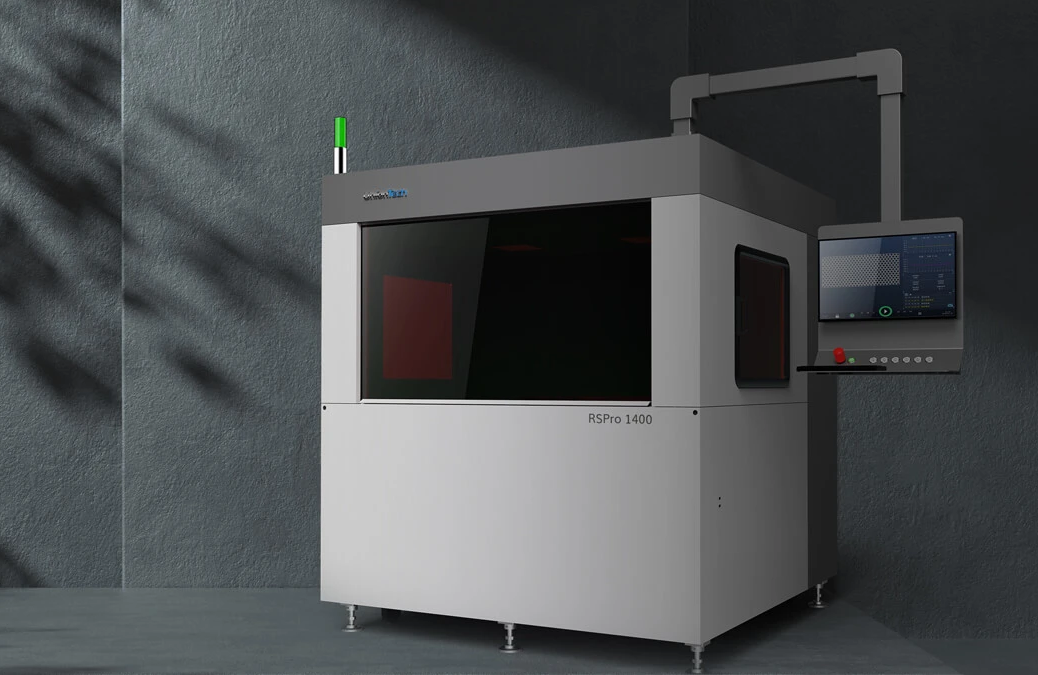
In advanced manufacturing, the transition from traditional machining to additive processes is driven by one established requirement: repeatable precision. When sourcing a stereolithography 3D printer for sale, decision-makers are not just buying a machine; they are investing in a process that can consistently hold tolerances of ±0.05 mm. Understanding the mechanics behind this accuracy is essential for integrating 3D printing into high-stakes production lines.
The Role of Photopolymerization in Accuracy
Stereolithography achieves superior precision through the principle of photopolymerization. Unlike FDM printers that extrude melted plastic, an SLA system uses a high-precision UV laser to trace the cross-section of a part onto a pool of liquid resin. Because the laser beam can be focused to a nominal spot size as small as 70 microns, it can capture intricate geometries and sharp edges that are impossible for mechanical nozzles to replicate. This “point-to-point” solidification ensures that every layer adheres perfectly to the last, resulting in nearly isotropic parts with smooth “Class A” surface finishes.
Engineering Stability with UnionTech Systems
Achieving industrial-grade accuracy requires more than just a laser; it requires mechanical stability and advanced control software. As a globally recognized industrial 3D printer manufacturer, UnionTech engineers its systems—such as the RSPro and Pilot series—with heavy-duty frames and closed-loop control systems.
The precision is achieved through key technical factors: high-speed galvanometers for accurate laser path following; precise layer control to balance speed and detail; and material consistency via resins with minimal shrinkage, developed with leading chemical partners to ensure dimensional stability.
From Digital Design to Functional Reality
For precision-driven manufacturing, the value of high-accuracy SLA is unequivocal: it removes the uncertainty from prototyping and streamlines the path to production. Whether you are producing tire molds with complex tread patterns or thin-walled aerospace housings, the ability to rely on the printed part’s dimensions allows for faster assembly and reduced waste. By choosing industrial-grade SLA, companies can bridge the gap between design and end-use production with total confidence in their output.