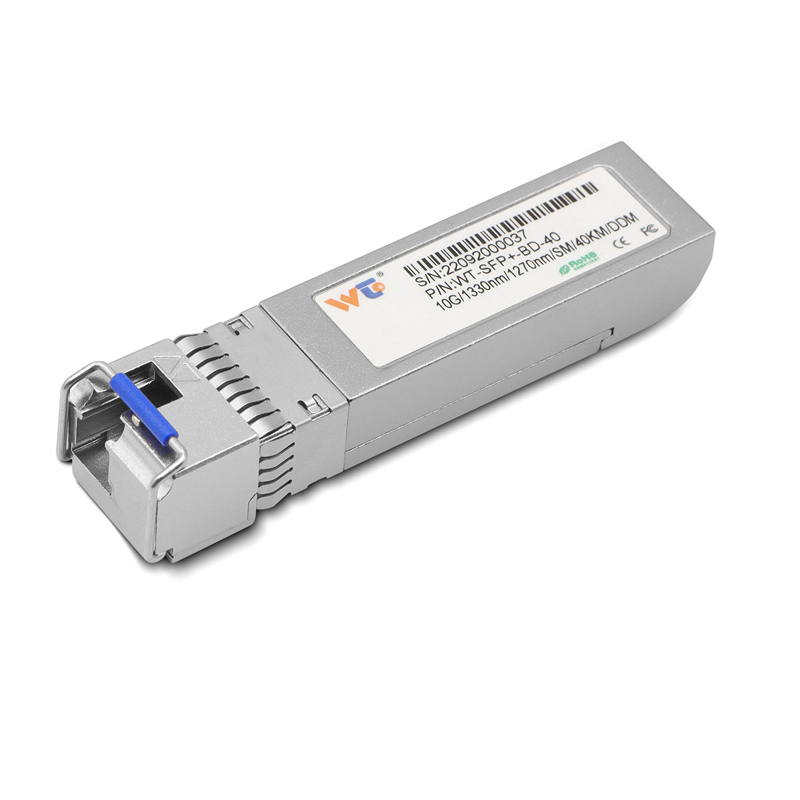
Growing bandwidth requirements are putting greater pressure on fiber infrastructure, especially where existing cable routes must support higher-speed connections without major reconstruction. For network operators, enterprises, and infrastructure integrators, replacing or expanding fiber can be expensive when physical pathways are limited. 10G SFP+BiDi transceiver technology addresses one important challenge by enabling bidirectional communication over a single strand of single-mode fiber, helping organizations make better use of existing fiber resources.
Reducing the Need for Two Fiber Strands
Traditional duplex optical links generally use separate fiber strands for transmitting and receiving data. That arrangement works well when sufficient fiber capacity is available, but it can become restrictive in networks where only one usable strand remains.
BiDi technology takes a different approach. It uses different optical wavelengths for the upstream and downstream directions, allowing both signals to travel over the same fiber strand. Commercial BiDi SFP+ modules commonly pair wavelengths such as 1270 nm and 1330 nm for this purpose.
This capability can be particularly valuable for network upgrades. Instead of installing another fiber strand, operators can potentially use an existing single-mode fiber path for a 10G connection, provided that the complete link is designed with compatible BiDi modules at both ends.
Making Better Use of Existing Fiber Infrastructure
Fiber availability is not always evenly distributed across a network. A site may have spare capacity in one route while another route has limited strands because of construction constraints, legacy installations, or difficult cable pathways.
A 10G SFP+BiDi solution can help address this resource imbalance. By carrying both directions over one strand, BiDi reduces the number of fibers required for the optical connection itself. This does not mean that every existing fiber link can immediately support BiDi; engineers still need to verify fiber type, link budget, connector configuration, wavelength pairing, and equipment compatibility.
For organizations managing extensive installed infrastructure, this approach can make network expansion more practical without automatically requiring new cable deployment.
Extending 10G Connectivity Over Longer Distances
Another challenge is delivering 10G connectivity between locations separated by substantial distances. Copper-based connections have practical distance limitations, while short-reach optical modules are designed for much shorter fiber links.
Long-reach BiDi modules are designed for single-mode fiber and can support connections extending tens of kilometers, depending on the module specification and link conditions. For example, 10G BiDi products are available with a rated reach of up to 40 km over SMF.
This makes the technology relevant to applications such as campus interconnection, metropolitan networks, telecom infrastructure, and links between distributed facilities. The actual deployment distance should still be evaluated against optical power, receiver sensitivity, connector losses, splices, and other link-budget factors.
Simplifying Cabling in Space-Constrained Sites
Cable management becomes increasingly important as network equipment is added to existing racks and communication rooms. Every additional fiber strand requires appropriate routing, termination, labeling, and maintenance.
Because BiDi can operate over a single fiber strand, it can reduce the fiber count associated with a point-to-point optical connection. That can simplify certain installations and make better use of limited pathways. Single-LC configurations are also commonly associated with BiDi modules, providing a compact physical interface for optical connections.
For network integrators, the benefit is not simply fewer cables. Reduced fiber requirements can also make certain upgrade projects easier to plan where existing ducts, panels, or cable trays have limited spare capacity.
Choosing Matched Wavelength Modules
BiDi deployment requires careful attention to wavelength pairing. The two ends of the link cannot simply use identical modules because each direction requires complementary transmit and receive wavelengths.
For instance, one module may transmit at 1330 nm and receive at 1270 nm, while its matching module performs the opposite function. Wintop’s WT-SFP+-BD-40 follows this configuration, using a 1330 nm transmit wavelength and 1270 nm receive wavelength. Wintop also lists the complementary WT-SFP+-BU-40 module with 1270 nm transmission and 1330 nm reception.
This paired design should be confirmed before procurement and installation. Mixing incompatible wavelength configurations can prevent the optical link from establishing properly.
Wintop’s 40 km 10G BiDi Option
For projects requiring extended 10G connectivity over SMF, Wintop’s WT-SFP+-BD-40 is a commercial-grade SFP+ module designed around this single-fiber approach. The official product specification lists an SFP+ package with an LC connector, 1330 nm transmission and 1270 nm reception, and transmission of up to 40 km over SMF. It supports a 10.3125 Gbps data rate.
The module uses a DFB laser and PIN-TIA photodetector, operates from a +3.3 V single power supply, and has power dissipation below 1 W. Wintop also specifies DDM support, 0–5 dBm average output power, and receiver sensitivity of at least -15 dBm.
Turning Fiber Constraints Into Deployment Options
The value of BiDi technology lies in how it addresses practical infrastructure limitations: insufficient fiber strands, long-distance 10G requirements, and restricted cable pathways. However, successful deployment still depends on proper wavelength matching, compatible equipment, suitable SMF, and sufficient optical link budget.
Wintop, founded in 2004, is a network equipment supplier and national high-tech enterprise specializing in the R&D, production, and sales of optical modules and switches. Its portfolio includes optical transceivers and networking equipment for enterprise and industrial applications.
For network operators and system integrators evaluating single-fiber 10G upgrades, Wintop can provide optical module options suited to specific link requirements. Contact Wintop to discuss 10G SFP+BiDi transceiver requirements and find a suitable solution for your fiber deployment.