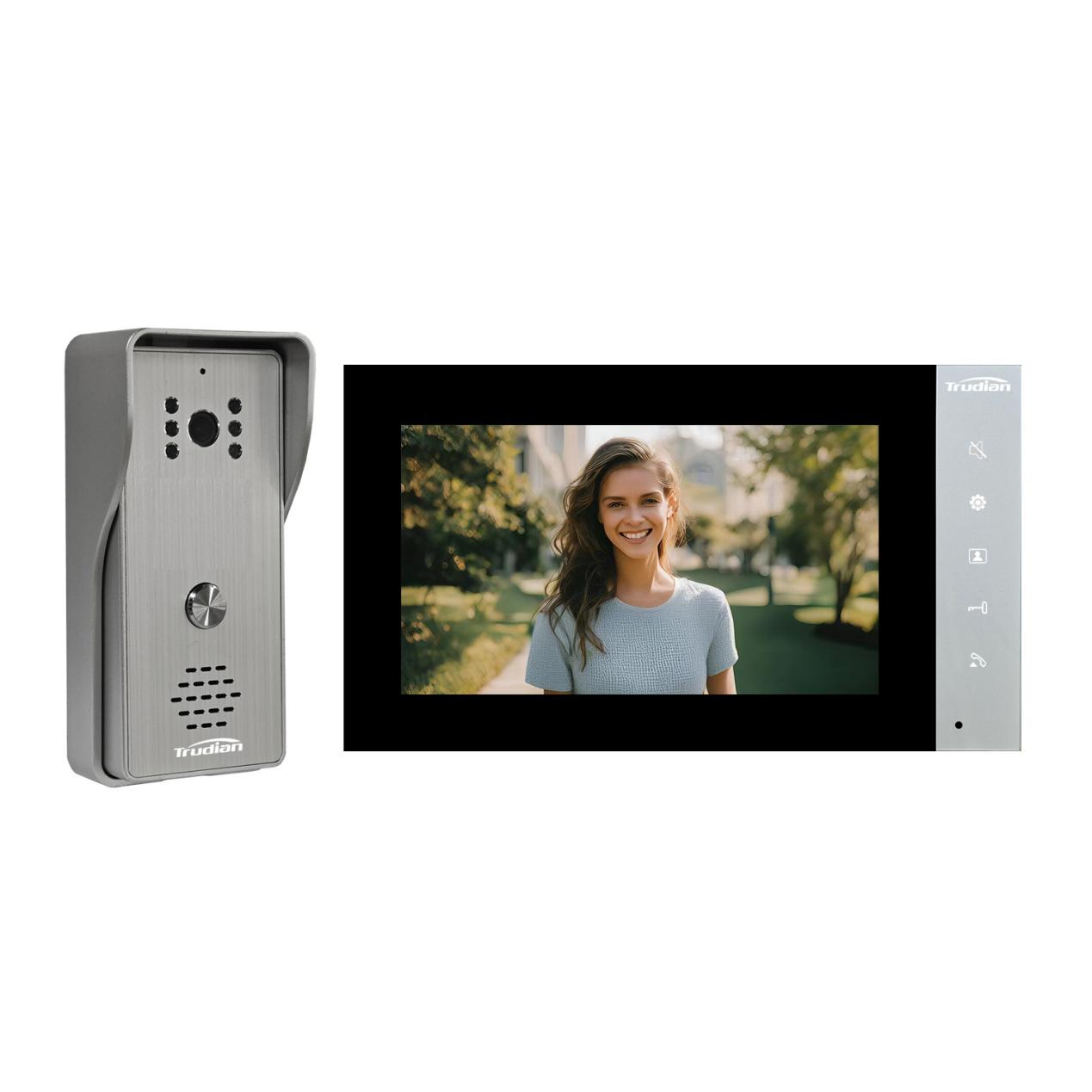
In the world of home and villa security, the analog video door phone remains a foundational choice due to its stability, simplicity, and reliable performance. Unlike complex, network-dependent IP systems, the analog system operates on a straightforward, dedicated wired connection, ensuring communication and security are always available.
The question, “How does an analog video door phone work?” is best answered by exploring the function of its two core components—the outdoor station and the indoor monitor—and the purpose of its dedicated wiring system. As a long-standing expert in security solutions, Trudian utilizes modern Analog High Definition (AHD) technology to deliver superior video quality through this time-tested, stable architecture.
The process is a simple, closed circuit designed for instant, high-quality communication between two points.
The Architecture: A Simple, Dedicated 4-Wire Circuit
At its core, the operation of an analog video door phone relies on a dedicated cabling system, traditionally a 4-wire circuit, to transmit all necessary signals simultaneously. This physical separation of signals is what guarantees the system’s high reliability and zero latency.
The Role of the 4-Wire Cable
While modern IP systems often bundle everything onto two wires (plus a network connection), the 4-wire AHD analog video intercom typically dedicates its wires to specific functions, ensuring clarity and power delivery:
- Power: One wire carries the necessary DC power to the outdoor station and often the lock mechanism.
- Ground/Return: A second wire completes the circuit for the power supply.
- Video: A dedicated wire transmits the analog video signal from the outdoor camera to the indoor monitor.
- Audio & Control: A final wire manages the two-way audio (talk/listen) and control signals, such as the command to unlock the door.
Because the system relies on physical, direct wiring rather than digital packet transmission over a shared network, the connection is virtually immune to WiFi interference, network congestion, or internet outages. This makes the Trudian analog video door phone an ideal solution for stability, especially in environments with long cable runs or poor network coverage.
Communication Flow: From Call Button to Access Granted
The entire operation, from the moment a visitor arrives to the moment a door is unlocked, follows a predictable, instantaneous sequence:
| Step | Action at the Analog Video Door Phone | Signal Transmission & Result |
| 1. Visitor Alert | The visitor presses the call button on the Trudian outdoor station. | An electrical signal (via the control wire) is instantly sent to the indoor monitor. |
| 2. Visual & Audio Link | The indoor monitor receives the signal, automatically turns on, and displays the camera feed. | The dedicated video wire transmits the live video. The audio wire prepares for two-way communication. |
| 3. Verification & Talk | The resident sees the visitor and presses the “Talk” button on the indoor monitor. | The two-way audio circuit is completed, allowing simultaneous talk and listen without the delay of digital processing. |
| 4. Access Control | The resident presses the “Unlock” button on the indoor monitor. | A brief electrical switch signal is sent via the control wire to the electric lock mechanism at the door, momentarily opening the circuit. |
The Power of AHD Analog Video Intercom
While traditional analog systems (CVBS) were limited by low-resolution video, modern AHD analog video intercom technology has revolutionized what can be transmitted over the classic wiring. AHD (Analog High Definition) is the innovation that allows the analog video door phone to deliver high-definition video quality (like 720P or even 1080P) over the same simple 4-wire cabling.
This technology provides a significant advantage for property owners looking for high security without the complexity and cost of a full IP system overhaul:
- High-Resolution Clarity: The AHD protocol encodes video signal at a much higher resolution, ensuring the indoor monitor displays clear, detailed images for accurate visitor identification.
- Zero Latency:5 Because the video signal is transmitted continuously as an electrical wave, there is virtually no signal delay (latency), ensuring real-time communication that feels immediate and natural.
- Simple Upgrade Path: For properties with existing copper wiring from older intercoms, an AHD system often allows for a simple replacement of the indoor and outdoor units, utilizing the existing wiring infrastructure.
Integrated Features for Modern Security
The simplicity of the analog video door phone’s core function does not preclude it from supporting modern security features. The Trudian TD-D3R36 analog kit, for example, integrates security enhancements directly into the wired system:
- Remote Door Unlocking: The dedicated control wire allows the system to interface directly with electric strikes or magnetic locks, providing secure remote access control from the indoor monitor.
- Clear Night Vision: Built-in infrared (IR) LEDs on the outdoor station automatically activate in low light, ensuring the camera feed remains clear and functional 24 hours a day.
- Monitoring: Residents can initiate the connection from the indoor monitor to the analog video door phone at any time to check the entrance area, providing an added layer of surveillance without a visitor needing to press the call button.
In conclusion, an analog video door phone works by establishing a direct, dedicated, and highly stable wired connection between the entry point and the resident. Through the use of AHD technology, systems from Trudian combine this rock-solid reliability with modern high-definition video, offering a cost-effective and dependable solution for residential security.