In the modern landscape of high-speed manufacturing, the demand for guaranteed traceabilityand quality assurance is non-negotiable. This necessity has cemented the laser marking system as an essential tool, allowing manufacturers to apply permanent, high-contrast identifiers—such as serialization codes to complex logos—with unparalleled speed and precision. While the core function of a laser marking system relies on a high-energy light beam to alter a material’s surface, its true reliability, flexibility, and efficiency in a dynamic industrial setting hinge entirely on advanced 3D vision guidance. This critical guidance is delivered by a sophisticated component: the industrial laser camera, which transforms the marking process from a static, pre-programmed operation into a truly intelligent, automated solution integral to all serious 3d machine vision camera applications.
The Operational Fundamentals of a Laser Marking System
A laser marking system is fundamentally a non-contact processing tool that utilizes a highly focused beam of light, generated by sources such as fiber, CO2, or UV lasers, to create a permanent and durable mark. This approach eliminates the wear and tear associated with physical stamping or the smearing risks of inkjet printing. The actual physical marking can be achieved through several high-precision methods: annealing (localized heating to create contrast without removing material, often for metals), ablation or engraving (vaporizing material to create a deep mark), or foaming/color change (altering plastics via rapid heating to create a visible contrast).
However, traditional 2D marking systems are inherently limited. They operate efficiently only when the target object is perfectly positioned and perfectly flat. The reality of industrial automation, particularly in sectors dealing with castings, irregularly shaped components, or parts presented randomly in bins, dictates that objects are rarely presented in a controlled 2D plane. When the object’s surface is curved, sloped, or the object is randomly oriented, the laser’s focal point will drift, resulting in blurry, inconsistent, or defective marks. This challenge is overcome only by integrating a highly accurate 3D spatial awareness system—a role perfectly fulfilled by an industrial laser camera.
The Laser Camera: Enabling 3D Spatial Awareness
The laser camera acts as the eyes of the automated marking cell, providing the crucial three-dimensional data necessary for the laser marking system to adapt its operation in real-time. This is achieved through the principle of structured light, often using laser projection to create a highly accurate scan. By leveraging geometric triangulation, the system instantly processes the distorted pattern to construct a dense, high-resolution point cloud—a digital map of the object’s full surface topography. This point cloud is the foundation for two paramount guidance functions in automation: First, it provides the exact six-degree-of-freedom (6D) pose of the object, instructing the robotic arm or gantry on the precise X, Y, Z position and the rotational orientation (roll, pitch, yaw) needed to align the marking path correctly. Second, and most critically for the laser itself, it enables Dynamic Focus Adjustment. The camera maps the surface contours, allowing the control system to continuously adjust the laser’s focal length as the beam travels along curves and slopes. This guarantees the spot size and energy density remain optimal, ensuring a sharp, high-quality mark regardless of surface irregularity.
Precision Engineering for Industrial Resilience
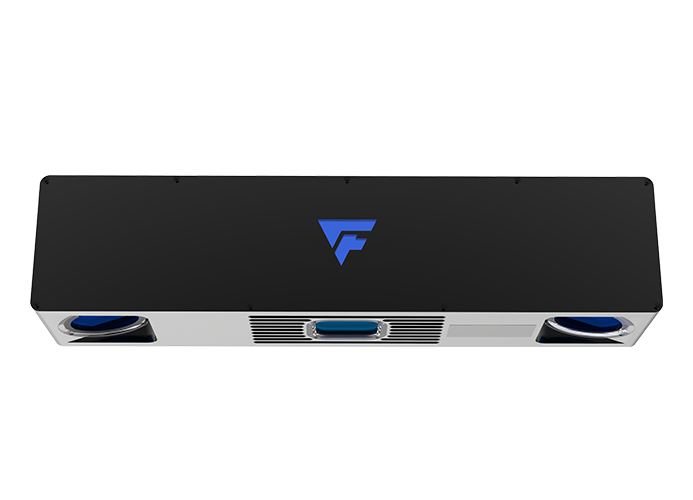
To be viable for industrial B2B deployment, a laser camera must demonstrate high accuracy alongside exceptional resilience to harsh operational environments. The Transfer3D Epic Eye Laser L V2S, for example, is specifically engineered as a smart-camera system to function reliably in challenging factory conditions, which often include high ambient light or the reflective surfaces common in metal processing.
The technical specifications of the Epic Eye Laser L V2S underscore its capability to address these industrial complexities: It is designed with a large Optimal Working Distance of 1200–3000 mm, which offers flexibility in mounting and integration over large workspaces. It delivers reliable Precision of 0.43 mm @ 2.4m over this extensive range, validating its use in demanding applications like large-scale depalletizing and assembly. The camera also boasts a blue (450nm) laser light source design that grants it superior Ambient Light Resistance of up to 120,000 Lux, ensuring the 3D data capture is not compromised by sunlight or intense facility lighting.
This combination of a wide field of view (Far FOV up to 2800×2625 @ 3.0m) and high environmental tolerance means that the 3D machine vision camera can quickly acquire the necessary data, with a typical capture time of just 0.4s to 0.9s, without halting production or requiring environmental modifications. These precise, verified specifications are crucial factors that differentiate true industrial-grade 3D vision systems.
Maximizing Automation and ROI with Transfer3D
Integrating the laser camera and laser marking system is what allows manufacturers to achieve higher throughput and a superior return on investment (ROI). The comprehensive vision software platforms offered by Transfer3D complement the hardware by rapidly converting the raw point cloud data into actionable machine commands.
For automation engineers, this means that the systems can handle unprecedented levels of part variability. Parts can be loaded randomly—in bulk bins or on misaligned pallets—and the 3D machine vision camera will instantaneously locate the component, guide the robot to the optimal pick or mark location, and provide continuous feedback for quality control. This level of integrated intelligence ensures the laser marking system applies its mark not only in the correct X/Y position but also at the correct Z-depth and focal distance, maintaining high quality and accuracy across the entire production run. By moving beyond static programming and embracing dynamic 3D vision guidance, the industrial laser camera empowers manufacturers to achieve true flexibility and maintain the critical traceability required in the competitive global market.