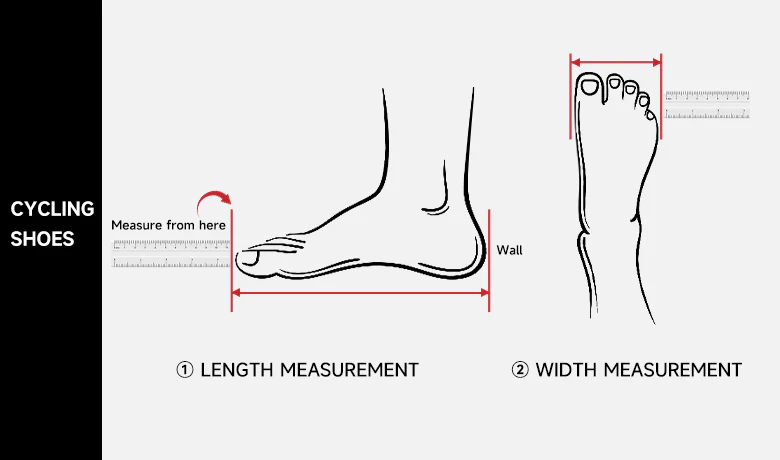
Proper footwear selection hinges on obtaining accurate physical measurements rather than relying on arbitrary shoe size numbers. Riding efficiency and comfort depend heavily on how securely footwear holds the foot without creating tight pressure spots over long distances. Mastering how to measure foot length gives cyclists the precise baseline needed to choose well-fitting performance gear.
Determining correct sizing parameters prevents common riding discomforts like numbness, arch fatigue, and hot spots. Specialized gear designed by Santic utilizes ergonomic sole contours that perform best when paired with precise foot dimensions.
Essential Tools Required for Home Foot Measurement
Gathering basic supplies before starting ensures clean results without unnecessary movement. A blank sheet of paper larger than the foot, a sharp pencil, a flat wall surface, and a ruler or metric tape measure form the standard toolkit. Wearing typical cycling socks during measurement produces realistic volume readings.
Conducting measurements on hard, level floors prevents paper shifting or soft carpet sinking. Soft surfaces distort tape readings, yielding inaccurate length numbers. Setting up on hardwood or tile flooring yields the most reliable results.
Wall Alignment Technique for Heel Stabilization
Positioning a sheet of paper flat on the floor against a bare wall creates a true zero point for measurement. Standing firmly on the paper with the heel lightly touching the vertical wall surface stabilizes the rearfoot. Weight should rest naturally on the foot to replicate standing pedal loads.
Relying on helper assistance or keeping the body upright prevents leaning forward, which can shift foot positioning. Maintaining full heel contact with the wall establishes a consistent back boundary. This flat wall interface forms the foundation of accurate metric tracking.
Marking the Longest Toe Line Accurately
Holding a pencil strictly perpendicular to the floor prevents the tip from angling under or away from the toe curve. Drawing a light horizontal line across the tip of the longest toe captures the true maximum length. Note that the longest toe is not always the big toe; the second toe frequently extends further forward.
Taking time to identify the furthest forward point avoids purchasing footwear that pinches the forefoot. Tilting the pencil outward adds false length, while slanting inward shortens the true reading. Vertical accuracy guarantees reliable millimeter measurements.
Measuring Distance and Converting to Millimeters
Removing the foot reveals the clear boundary lines left on the paper. Measuring the straight distance from the paper edge that touched the wall directly to the marked toe line determines the final result. Metric units like millimeters provide far higher precision than imperial fractions or standard shoe sizes.
Recording length down to the nearest millimeter simplifies cross-referencing manufacturer sizing charts. Most cycling brands publish footbed dimensions in millimeters to help riders avoid regional conversion errors. Metric precision supports better footwear fitting.
Measuring Forefoot Width for Volume Assessment
Length accounts for only part of total foot geometry, making width evaluation equally important. Standing on the paper, mark the outermost points on both sides of the widest part of the forefoot across the metatarsal joints. Measuring the distance between these two marks yields the forefoot width.
Comparing width measurements against standard lasts reveals whether wide-fit options are required. Cyclists exploring options from Santic benefit from evaluating width metrics to select uppers that accommodate natural forefoot splay. Proper width prevents lateral squeezing during high-torque pedaling efforts.
Measuring Both Feet and Account for Asymmetry
Human bodies rarely display identical left and right dimensions, making dual-foot testing crucial. Measuring both feet independently highlights subtle differences in length or width between limbs. Always select shoe sizes based on the larger foot to prevent chronic pinching or blister formation.
Accommodating the larger foot keeps toes from jamming into front toe caps during intense efforts. Extra space in the shoe for the smaller foot can easily be adjusted using minor closure strap adjustments or internal footbed inserts. Sizing for the larger side preserves foot health across both legs.
Factoring in Diurnal Foot Expansion Dynamics
Feet naturally swell throughout the day as fluid accumulates from walking and standing. Measuring foot dimensions in the late afternoon or evening captures maximum natural expansion. Conducting tests early in the morning often yields undersized numbers that lead to tight fits later on the road.
Understanding how to measure foot length under realistic conditions ensures footwear remains comfortable during hot multi-hour rides. Blood flow increases significantly under sustained physical exertion, expanding foot volume further. Late-day measurements account for this thermal expansion naturally.
Applying Metric Measurements to Sizing Charts
Manufacturer size charts translate raw millimeter length and width data into specific shoe models. Comparing measured numbers directly against the chart’s footbed lengths removes guessing from online purchases. Leaving approximately three to five millimeters of toe room provides space for thermal swelling without loose foot slippage.
Checking how closure systems adjust helps fine-tune volume around the instep. Apparel and footwear developed by Santic feature structured heel cups and micro-adjustable closures that secure feet once correct length parameters are established. Matching metric data to chart guidelines guarantees dependable, long-distance riding support.
Conclusion
Obtaining exact millimeter measurements at home replaces guesswork with reliable physical data when selecting cycling footwear. Measuring both feet under realistic weight-bearing conditions and factoring in width metrics prevents forefoot compression and heel slippage. Applying systematic measurement methods equips cyclists with the foundation needed for long-distance comfort and maximum pedaling efficiency.