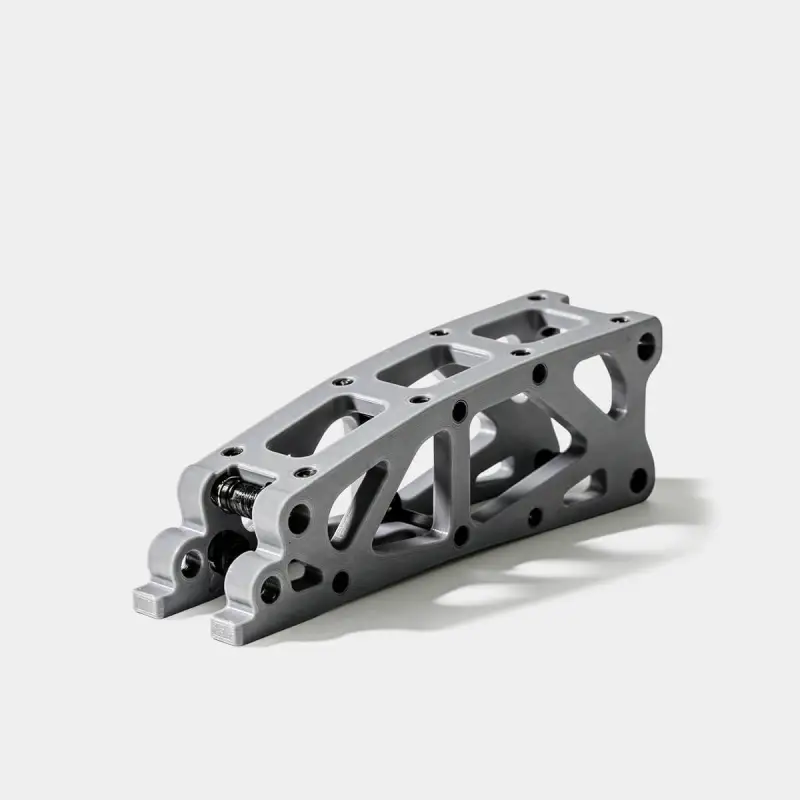
Large-format 3D printing can become difficult when warping causes parts to lose their intended shape or dimensional accuracy. Material choice is therefore an important consideration when printing large models and structural components. SUNLU PA6-GF, a glass fiber reinforced nylon 3D print filament, contains 25% high-strength glass fiber to enhance dimensional stability, helping large and complex parts maintain uniform shrinkage and reduce warping during printing.
Why Warping Matters When Printing Large Parts
Warping can be particularly problematic when a printed component needs to remain flat, precise, and structurally consistent. A distorted part may no longer meet the dimensional requirements of an engineering application, while repeated failed prints can consume additional material and production time.
For large-scale models, the challenge becomes even more important because the printed structure has a greater area over which dimensional changes can occur. Choosing a material that supports stable shrinkage can therefore help improve the likelihood of producing an accurate finished component.
PA6-GF Combines Nylon with Glass Fiber
SUNLU PA6 Glass Fiber (PA6-GF) is a glass fiber reinforced nylon material developed for applications that require high strength, excellent wear resistance, and structural stability. Its material composition includes 25% high-strength glass fiber, which is a key feature for users concerned about dimensional stability when printing large or complex parts.
Rather than relying only on the base nylon material, the glass fiber reinforcement provides enhanced stability to the printed structure. This makes PA6-GF particularly relevant when the finished component must maintain its intended shape and dimensions after printing.
How 25% Glass Fiber Helps Reduce Warping
The 25% glass fiber content greatly enhances the dimensional stability of printed parts. During printing, the material maintains uniform shrinkage, which helps minimize warping and deformation. This characteristic is especially valuable for large-scale models where dimensional changes can have a significant effect on the finished result.
Uniform shrinkage can also make the printing process more predictable. When a material maintains better structural stability during printing, users can work toward flat and precise finished parts without frequent parameter adjustments. This can contribute to a more consistent production workflow.
Large Models Need Stable Material Behavior
Large models and complex structural components place particular importance on dimensional stability. Even relatively small deformation can affect the overall geometry of a large printed part, potentially making it unsuitable for its intended purpose.
PA6-GF is designed to address this requirement through its 25% high-strength glass fiber reinforcement. The material can maintain uniform shrinkage when printing large-scale models or complex structural components, helping reduce the risk of deformation and supporting more precise finished parts.
For businesses using 3D printing for engineering applications, this characteristic can be valuable because accuracy and repeatability are often closely connected to production efficiency. A material that supports stable dimensions can help reduce the need to discard parts affected by warping.
Choosing Engineering Filaments for Functional Parts
Not every 3D print filament is intended for the same type of application. When a component needs high strength, wear resistance, and structural stability, engineering filaments can provide a more suitable material option.
SUNLU PA6-GF is positioned for engineering applications and functional parts that require high precision and stability. Its glass fiber reinforcement supports the dimensional stability needed for these applications while also contributing to the material’s high-strength characteristics.
For businesses selecting engineering filaments, the intended application should guide the decision. Large structural components and functional parts with strict precision requirements can benefit from a material specifically designed around stability and strength.
Improving Printing Success and Reducing Waste
Warping does not only affect the appearance of a finished component. A deformed part may need to be printed again, increasing material consumption and extending production time. For businesses managing multiple printing projects, these repeated failures can become an avoidable cost.
PA6-GF can help address this issue by maintaining uniform shrinkage during printing. According to the provided material information, users can achieve flat and precise finished parts without frequent parameter adjustments. This can improve printing success rates while saving material and time costs.
The benefit is particularly relevant to large-scale printing. When a large component fails late in the process, the lost material and printing time can be considerably more significant than with a small model. Supporting dimensional stability from the material level can therefore contribute to a more efficient workflow.
PA6-GF for High-Precision Engineering Applications
A suitable engineering 3D print filament should support both the functional requirements of the finished component and the practical demands of production. PA6-GF combines high strength and excellent wear resistance with enhanced dimensional stability from its 25% glass fiber content.
This combination makes it especially suitable for engineering applications and functional parts that require high precision and stability. For large-scale models and complex structural components, its ability to maintain uniform shrinkage can help minimize warping and deformation.
Building a More Reliable Large-Part Workflow
Successful large-part printing depends heavily on maintaining dimensional stability throughout the printing process. Material selection is therefore an important starting point for businesses seeking to reduce warping, failed prints, and unnecessary material consumption.
SUNLU PA6-GF offers a focused solution through its 25% high-strength glass fiber reinforcement. By enhancing dimensional stability and maintaining uniform shrinkage, this engineering filament helps users pursue flat, precise finished parts for demanding engineering and functional applications. For large models and complex structures, that stability can translate into higher printing success rates and more efficient use of time and material.