Reward seeking behavior and drug reinforcement are related but not interchangeable concepts in rodent studies. Reward-seeking behavior describes what the animal does to obtain an expected outcome, such as pressing a lever or making a nose-poke response.
Drug reinforcement concerns the effect of drug delivery on that behavior and whether the drug-reward relationship supports continued responding. Choosing endpoints therefore starts with identifying which part of the behavior the experiment is designed to measure.
Define the Behavioral Endpoint First
The same operant chamber can generate several types of measurements, but they answer different questions. Response counts describe how frequently an animal performs the required action. Effective and ineffective responses provide more detail about which actions produce the programmed consequence and which do not.
For reward-seeking behavior, researchers may focus on response frequency, response patterns, reward counts, and event timing. These measurements show how the animal interacts with the task. They are particularly useful when the primary question concerns motivation, operant learning, or changes in reward-directed responding.
For drug reinforcement, the relationship between the response and drug delivery becomes more important. Infusion times, infusion volume, reward status, and the number of drug administrations can be examined together with lever activity. This connects the behavioral response with the programmed pharmacological consequence.
Separate Active and Control Responses
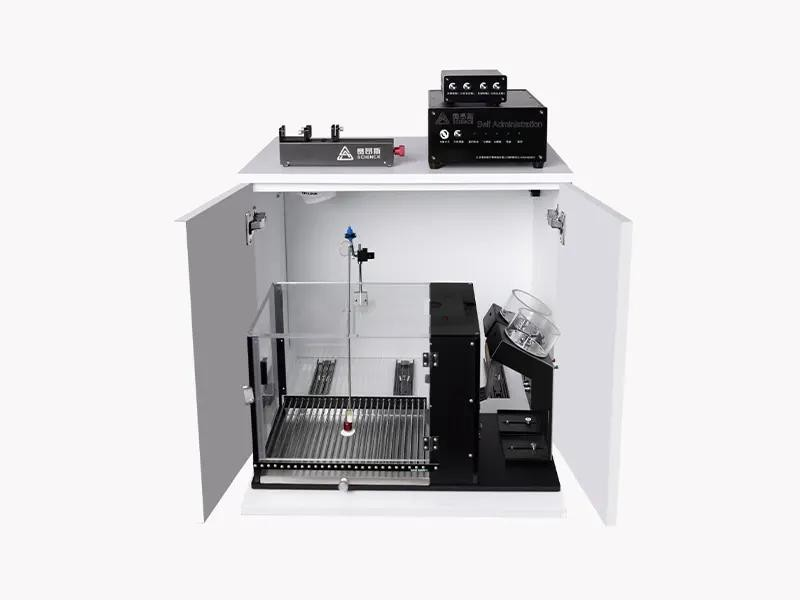
A useful comparison involves responses that trigger the programmed reward and responses that do not. The self-administration setup records effective and ineffective lever responses and can distinguish left- and right-lever activity.
This allows researchers to examine whether changes are associated with the reward-linked response rather than simply reflecting increased general activity.
This distinction is relevant when interpreting reward-seeking behavior because a high response count alone does not indicate why the animal is responding. Comparing response categories provides additional context about the relationship between the operant action and the programmed outcome.
Tracking both response types across sessions can also show whether behavioral changes are concentrated in the reward-linked response or occur more broadly.
Examine Reward Delivery Alongside Responses
Drug reinforcement cannot be separated from the delivery event. In an intravenous self-administration setup, the programmed response can initiate drug administration, creating a measurable sequence between action and outcome.
The system combines an operant chamber with a programmable syringe pump and drug delivery package. The pump supports speeds from 0.5 to 60 RPM and single doses from 0.001 mL to 1 mL.
These are equipment capabilities rather than universal study parameters; researchers select experimental settings according to the design and administration method.
Recording infusion timing and volume alongside response counts helps researchers examine how frequently the animal seeks the programmed outcome and how those responses relate to drug delivery.
Keeping these measurements linked at the session or event level also supports clearer interpretation when response rates and infusion patterns change at different times.
Use Timing to Add Behavioral Context
Response totals can conceal changes in when behavior occurs. Event timestamps allow researchers to examine the sequence of lever responses, infusions, and other recorded events within a session. This can be useful when response patterns change over time or when the timing of reward-related actions is part of the research question.
Head-entry detection, pellet reward counts, and video monitoring can provide additional behavioral information. Together, these measurements can help researchers examine engagement with the chamber and distinguish a change in reward-directed responding from a broader change in activity.
Match Endpoints to the Research Question
Endpoint selection should follow the behavioral process under investigation. Research centered on reward seeking behavior can give greater weight to effective responses, control responses, reward counts, and event timing. When drug reinforcement is the focus, infusion events, drug delivery parameters, and their relationship to operant responding become more relevant.
The self-administration platform is designed for reward-seeking, reinforcement learning, addiction, and behavioral pharmacology research. It supports both rats and mice and can manage up to 32 cages simultaneously through its software.
Sound and light cues can also be incorporated into operant conditioning and reinforcement protocols.
The choice of endpoint can also influence how data are organized for comparison. For example, response frequency may be examined by session, while infusion events can be aligned with individual responses.
Using measurements that directly correspond to the study question helps keep the analysis focused on the behavioral process being investigated.
Combine Endpoints Rather Than Isolate Them
A single behavioral measure rarely describes the complete response pattern. Effective responses show engagement with the programmed task, control responses add behavioral context, and infusion data connect responding with drug delivery.
Timing, reward counts, and head-entry events add further information about how the animal interacts with the experimental environment.
BioMed Easy places its Self-Administration system within the Reward & Addiction portfolio. The platform integrates the operant chamber, controller, programmable syringe pump, drug delivery components, cues, video monitoring, and analysis software into one setup for rodent research.
Researchers planning studies involving reward-seeking behavior can contact BioMed Easy to discuss the relevant endpoints and configure a system around their experimental requirements.