Lighting upgrades are increasingly important for factories, warehouses, retail facilities, and other commercial properties seeking lower operating costs without unnecessary construction work. However, replacing every existing fixture is not always the most practical approach. When the supporting infrastructure remains usable, an LED retrofit module can modernize the light source while retaining part of the existing system. The decision ultimately depends on fixture condition, compatibility, installation requirements, lighting performance, and the economics of the project.
Retrofit or Replacement: What Is the Difference?
An LED retrofit module is designed to replace existing lighting components while retaining some part of the installed fixture or infrastructure. This approach differs from installing a completely new luminaire, where the existing fixture is removed and replaced with a new integrated product. The U.S. Department of Energy recognizes retrofit kits as one of several approaches for upgrading existing lighting systems.
For facility managers, the distinction matters because the two approaches involve different installation scopes. A new fixture may provide a clean, purpose-designed lighting system, but it can also require more extensive removal, mounting, wiring, and disposal work. A suitable retrofit can reduce those requirements when the existing infrastructure is structurally sound and compatible.
When an LED Retrofit Module Makes More Sense
The strongest case for an LED retrofit module usually occurs when the existing trunking system is still in good condition. If the rails, mounting structure, and electrical infrastructure can continue serving the facility safely, replacing only the lighting components can avoid unnecessary reconstruction.
Compatibility is another major consideration. A retrofit is only practical when the new module can connect correctly with the existing system. Electrical characteristics, mechanical dimensions, connection methods, load requirements, and lighting distribution should all be verified before procurement. For industrial projects, these checks are particularly important because lighting systems may extend across large areas with many interconnected fixtures.
An LED retrofit module can also be attractive when a facility needs to upgrade lighting while limiting disruption to ongoing operations. The U.S. Department of Energy notes that retrofit kits can require less labor than complete new luminaires in some applications.
When a New Fixture Is the Better Choice
Retrofit is not automatically the best solution. Existing fixtures may have deteriorated housings, damaged wiring, inadequate thermal management, or obsolete mounting structures. In these situations, retaining the old infrastructure may create unnecessary technical or maintenance risks.
A new luminaire can also be preferable when the facility needs a substantially different light distribution or mounting arrangement. Purpose-designed luminaires can integrate the LED source, driver, optics, thermal management, and housing as one system. This can be advantageous when an existing fixture cannot deliver the required illumination pattern or when the entire lighting layout is being redesigned.
Project teams should also consider future control requirements. Commercial and industrial LED luminaires can support strategies such as occupancy sensing, task tuning, and dimming when the products and electrical systems are designed for them. A new fixture may therefore be more appropriate when controls and lighting redesign are central to the project.
How Lighting Refurbishment Can Reduce Project Disruption
For facilities with usable infrastructure, lighting refurbishment can offer a practical middle ground between maintaining outdated lighting and undertaking a complete replacement. The objective is not simply to install LED technology, but to improve performance while making sensible use of existing assets.
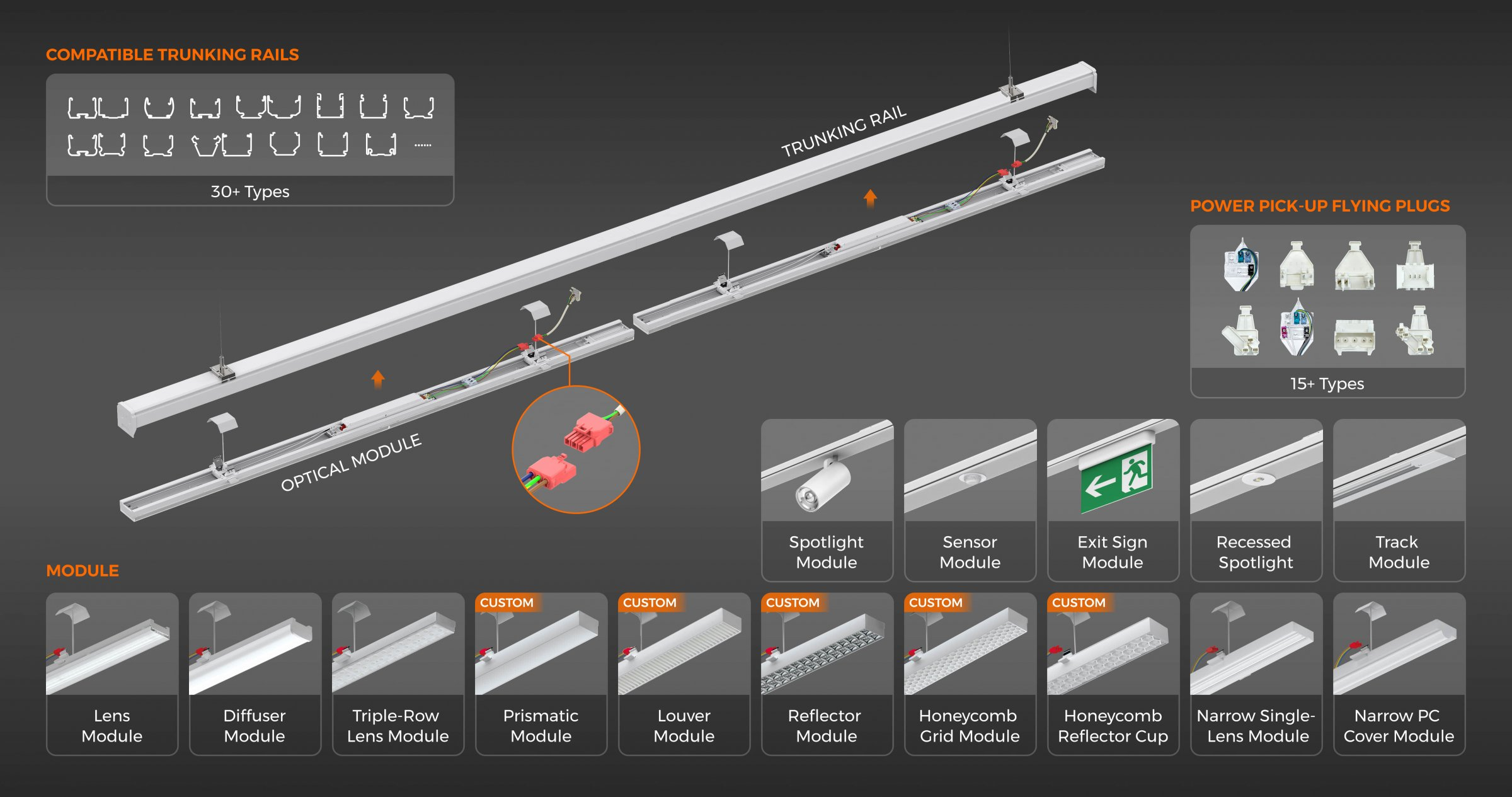
TRIECO’s DREAMFIT is designed specifically for LED trunking retrofit and system renewal in industrial and retail applications where the existing trunking circuit can be reused. Its power pick-up flying plugs are compatible with more than 30 types of mainstream European trunking rails, according to the supplied product specifications.
This connection approach is intended to avoid structural modifications, trunking replacement, and rewiring. For facility operators, such compatibility can simplify project planning and potentially reduce the amount of work required during installation. Actual project savings, however, depend on existing site conditions, labor rates, system configuration, and the condition of the retained infrastructure.
Evaluating DREAMFIT’s Performance for Commercial Projects
Lighting performance remains essential when comparing retrofit options. DREAMFIT is specified with a luminous efficacy of 180 lm/W and a luminous flux of 13,500 lm. Its stated efficiency classification is EU Energy Efficiency Standard ErP Class B, while its 13,500-lm output is positioned for main spatial illumination.
The 180-lm/W specification provides a useful benchmark for procurement teams comparing energy performance among suitable products. The U.S. Department of Energy explains that luminous efficacy, measured in lumens per watt, indicates how much light a luminaire produces for each unit of electrical power consumed.
However, efficacy should not be evaluated in isolation. Buyers should also examine illumination levels, beam distribution, color characteristics, operating hours, controls, warranty conditions, and compatibility with the existing trunking infrastructure. These factors determine whether a retrofit delivers the intended operational result.
A Practical Decision Framework for Facility Managers
Before choosing between a retrofit and a new fixture, facility managers can assess four areas. First, inspect the existing trunking, wiring, mounting components, and electrical infrastructure. Second, confirm that the proposed retrofit is mechanically and electrically compatible. Third, compare the expected installation work and operational disruption. Finally, calculate the total cost of ownership, including energy, maintenance, labor, and equipment costs.
Lighting refurbishment is particularly compelling when the existing infrastructure is serviceable and the retrofit can deliver the required light output and efficiency. A complete replacement becomes more attractive when the infrastructure is damaged, incompatible, or no longer suitable for the facility’s lighting requirements.
Making the Right Upgrade Decision
There is no universal answer to whether a retrofit or a new fixture is better. The appropriate choice depends on the condition and compatibility of the existing system, the required lighting performance, installation constraints, and the project’s financial objectives.
For industrial and retail facilities with reusable trunking infrastructure, TRIECO‘s DREAMFIT provides a targeted LED retrofit module approach, combining plug-in connections with 180 lm/W efficacy and 13,500 lm luminous flux. When supported by a thorough site assessment and lifecycle cost analysis, this type of solution can help businesses modernize lighting without automatically replacing infrastructure that remains fit for purpose.