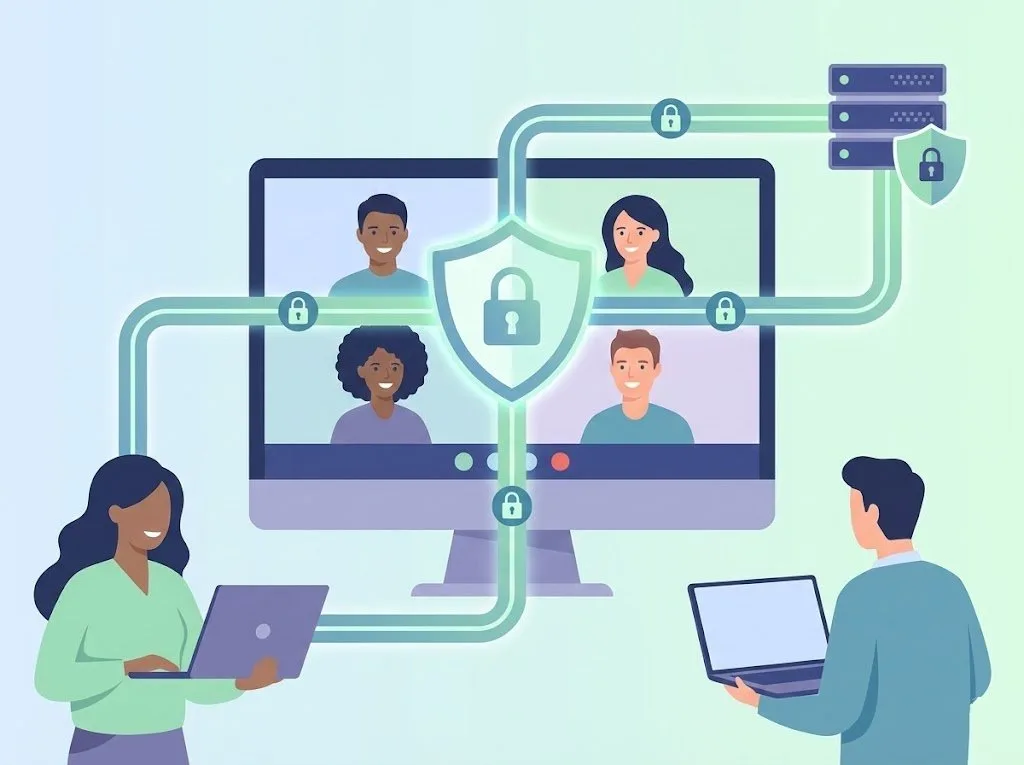
In today’s business environment, enterprises routinely handle vast quantities of sensitive data, from intellectual property and financial reports to proprietary customer information and personal identifiers. Protecting this information is not just a matter of best practice; it is a fundamental requirement enforced by global regulations like GDPR, HIPAA, and various national data sovereignty laws. While video conferencing has become an indispensable tool for collaboration, reliance on traditional, multi-tenant cloud platforms often creates unavoidable risks regarding data jurisdiction, access control, and compliance.
For organizations that cannot afford to compromise on privacy, the architecture of their communication tools is paramount. This is where the model of local deployment video conferencing, epitomized by platforms like VidyVault, emerges as a critical infrastructure choice, specifically designed to address stringent sensitive data requirements.
The Problem with Public Cloud Video Platforms
Traditional cloud-based video conferencing services often operate on shared infrastructure. Data, including metadata, recordings, and shared files, is stored on third-party servers that are legally and physically situated according to the provider’s operational footprint. This model presents several core challenges for high-security enterprises:
- Data Sovereignty: Data transmitted and stored resides outside of the organization’s direct geographical control. This complicates compliance for entities operating under strict regional data residency requirements.
- Shared Security Burden: While providers ensure platform security, the enterprise retains limited control over the fundamental infrastructure. Security relies on the provider’s policies, patching schedules, and incident response, creating a reliance that high-security businesses often seek to eliminate.
- Metadata Exposure: Even with end-to-end encryption for the meeting content, meeting metadata—such as participant identities, meeting times, and duration—is typically stored on the provider’s cloud, offering an avenue for potential analysis or external access.
Achieving Data Sovereignty Through Local Deployment
The defining characteristic of VidyVault is its architecture: it is a self-hosted, enterprise-grade video conferencing platform. This approach completely reframes the data security dynamic by shifting ownership of the communication infrastructure back to the enterprise.
When an organization opts for local deployment, the entire platform—from the signaling servers to the data storage—is installed and run on the company’s own servers, within their private data centre, or on a dedicated private cloud instance under their direct management. This self-hosted model provides a robust mechanism to meet sensitive data requirements in three key areas:
1. Full Control Over Data Residency and Access
By deploying VidyVault on-premises, enterprises achieve full data sovereignty. All audio, video, chat, file transfers, and crucial metadata are generated, processed, and stored exclusively within the organization’s perimeter. This eliminates the risk of data transiting international borders or being subjected to foreign surveillance laws. For regulated industries—such as finance, government, defense, and healthcare—this level of control is non-negotiable. The organization’s existing, audited security policies and access controls automatically govern the video conferencing environment.
2. Enhanced Infrastructure Security and Compliance
A locally deployed platform integrates seamlessly with the organization’s established security framework. This includes leveraging existing firewalls, intrusion detection systems, identity management protocols (like LDAP or Active Directory), and audit logging mechanisms.
VidyVault enhances this control by ensuring robust security features are deployed within the private environment. This includes end-to-end encryption and granular access management that adheres to zero-trust principles. Since the data remains entirely on the company’s infrastructure, the risk of data leaks stemming from a third-party breach is fundamentally mitigated. The IT team can maintain continuous oversight, ensuring immediate patch deployment and adherence to internal compliance mandates.
3. Guaranteed Performance and Scalability with Secure Video Conferencing
While the primary benefit is security, local deployment also ensures performance is dictated by the enterprise’s network capacity, rather than external factors. Built on the technical foundation of the industry-leading LiveKit, secure video conferencing with VidyVault is engineered for high performance. The platform supports large-scale deployments, facilitating secure, stable meetings for up to 2000 participants and delivering crystal-clear 4K video quality.
By owning the infrastructure, enterprises can provision and scale resources precisely as needed for critical business functions, ensuring low-latency connections and reliable uptime without competing with millions of other users on a public cloud.
Feature Specifications for Enterprise Use
To support professional and compliant collaboration, the platform is equipped with features tailored for the enterprise environment:
| Feature | Specification | Compliance and Security Benefit |
| Participant Scale | Supports up to 2000 attendees in a single meeting (Perpetual License). | Ensures communication stability for large-scale, highly regulated town halls or global summits. |
| Video Quality | Ultra-reliable, low-latency 4K video transmission. | Maintains professional standards without compromising data security or bandwidth efficiency. |
| Meeting Intelligence | AI-powered Intelligent Noise Cancellation, Live Captioning, and Automated Meeting Transcripts. | Improves accessibility and efficiency, with all processed data remaining on the company’s private server, maintaining security. |
The Strategic Value of Self-Hosted Communications
For enterprises dealing with trade secrets, confidential client information, or sensitive governmental communication, the investment in a self-hosted platform like VidyVault is a strategic business necessity.
The model ensures that organizational integrity, regulatory compliance, and control over sensitive communications are never outsourced to a third party. By choosing on-premises deployment, organizations take complete responsibility for their data, thereby fulfilling the most stringent requirements for privacy and security in the modern communication landscape. Secure video conferencing should empower control, and the self-hosted architecture is the definitive pathway to achieving this objective.