Choosing a generator for a business, residential property, outdoor event, or backup application involves more than comparing power output and fuel capacity. Noise can directly affect where a generator can be operated and how comfortable the surrounding environment remains. For buyers evaluating a petrol generator, the difference between a conventional model and a low noise generator can therefore become an important purchasing consideration. Firman’s generator range illustrates how quieter operation can be combined with practical backup power.
What Makes a Generator “Standard”?
A conventional generator is generally designed to provide dependable electrical output and straightforward operation, while the level of noise control varies by model. Its engine produces mechanical power that is converted into electricity by the alternator, while the overall design may place less emphasis on reducing the sound produced during operation.
Noise comes from several sources, including fuel combustion, mechanical movement, cooling airflow, exhaust systems, and vibration. Because these sources operate simultaneously, reducing generator noise requires more than simply adding insulation around the engine.
For commercial buyers, the appropriate choice depends heavily on the operating environment. A generator used at a construction site may operate in an environment where background noise is already high. A unit used near homes, offices, campsites, or customer-facing areas has different requirements.
How Does a Low Noise Generator Reduce Sound?
A low noise generator is designed with greater attention to acoustic performance. Manufacturers may combine enclosure design, engine-speed management, vibration control, exhaust treatment, and other engineering measures to reduce the perceived sound level.
Operating conditions also matter when comparing noise figures. Generator sound ratings are normally associated with a specified load and measurement distance, so two products should not be compared simply because their published numbers both use the unit “dB.”
Firman’s own buying guidance highlights quiet operation as a key consideration for camping and notes that the FIG5880 can operate quietly when ECO mode is activated. The company also identifies petrol generators as suitable for portable and intermittent backup applications.
Low Noise Generator vs. Standard Generator: Key Differences
The most obvious difference is acoustic performance. A standard generator may be acceptable where noise restrictions are limited, while a low noise generator is better suited to locations where sound needs to be controlled.
The second difference is operating environment. Businesses working near residential properties, hospitality facilities, temporary events, or recreational areas may benefit from a quieter machine. Reduced noise can make communication easier and help minimize disruption to people nearby.
The third difference is design philosophy. A standard generator may concentrate primarily on delivering dependable power, while a low noise generator integrates power generation with sound management. This does not automatically mean that every quiet generator delivers worse electrical performance; buyers still need to evaluate rated output, starting capacity, fuel consumption, runtime, and maintenance requirements.
What About a Petrol Generator for Backup Applications?
A petrol generator remains a practical option where portability and intermittent operation are important. According to Firman’s current product guidance, petrol generators are often suitable for portable and occasional backup, while diesel generators are more commonly selected for frequent operation and commercial applications.
For buyers, this distinction is useful because generator selection should begin with the application rather than the product label. A residential backup system may have different requirements from a construction project, retail outlet, workshop, or outdoor event.
Load calculation is equally important. Firman recommends adding the running power of connected appliances and accounting for starting requirements, particularly for equipment such as refrigerators and air conditioners.
Firman FIG5880: A Practical Low-Noise Example
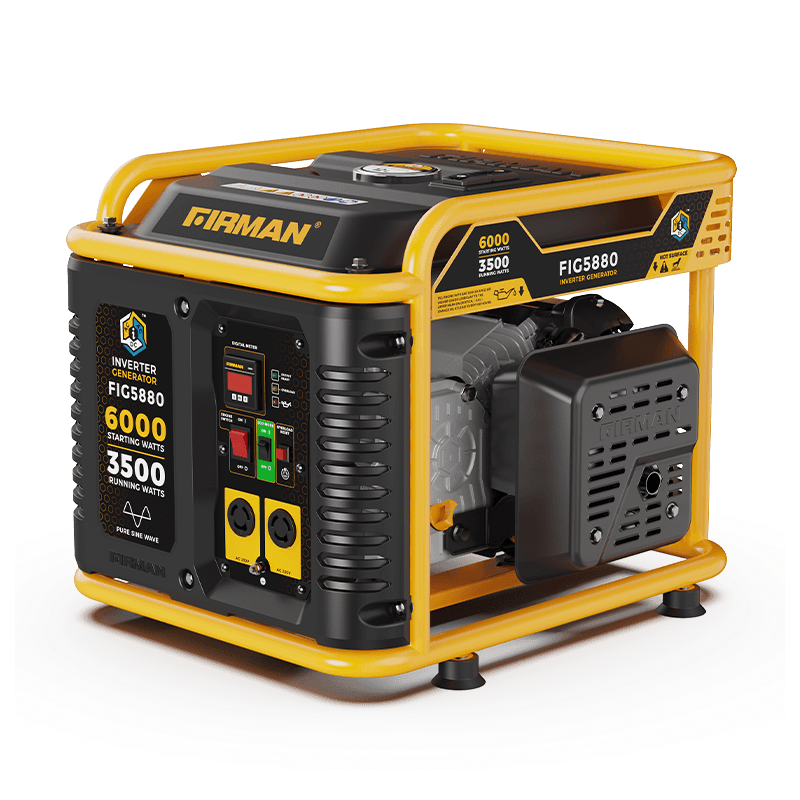
The Firman FIG5880 demonstrates how a petrol generator can combine relatively high output with noise-conscious design. Firman’s official product listing identifies the FIG5880 as a petrol generator with 6,000W starting watts and 3,500W running watts.
The model’s published product information specifies a 12L fuel tank, 223cc SFE225 engine, and recoil starting system. Its Night Whisper feature is rated at 64dB(A) at 7m under 25% load, positioning it as a low noise generator for applications such as residential backup, camping, and outdoor use.
These specifications also illustrate why noise should not be considered separately from power requirements. A buyer needing to support multiple appliances may value the FIG5880’s 3,500W running capacity, while its lower-noise design can make the unit more appropriate for environments where excessive generator sound is undesirable.
Which Generator Should Businesses Choose?
There is no universal winner between a standard generator and a low noise generator. The right choice depends on the operating location, required output, usage frequency, noise sensitivity, portability requirements, and total cost of ownership.
A standard model can make sense for demanding environments where sound is a secondary consideration. A low noise generator becomes more compelling when the generator will operate close to people, residential buildings, customers, campers, or employees.
For business buyers, the purchasing decision should therefore evaluate the complete operating profile rather than focusing on one specification. Noise level, power output, fuel consumption, runtime, starting performance, maintenance, and application suitability should be considered together.
Choosing Power Without Excessive Noise
Generator technology has increasingly made it possible to balance dependable power with a more controlled acoustic footprint. For buyers comparing a petrol generator with a low noise generator, the key distinction is not simply whether one machine is “quiet” and the other is “loud.” The more useful question is whether the generator’s acoustic performance matches its intended operating environment.
Firman’s FIG5880 provides one example of this approach, combining 3,500W running output with the Night Whisper low-noise design rated at 64dB(A) at 7m under 25% load. For businesses and professional users, evaluating these specifications alongside actual load requirements can lead to a more practical generator selection