Brackish water has more dissolved salts than fresh water but less than seawater. It is common in groundwater, industrial sources, and some municipal supplies. When salinity is too high, direct use can become difficult. Reverse osmosis is often selected because it can reduce dissolved salts through membrane separation.
The value of brackish-water reverse osmosis is not limited to drinking-water treatment. It can also support irrigation, industrial process water, boiler feed preparation, and higher-purity water production. The right design depends on feed-water quality, pretreatment, recovery target, and the final water requirement.
Why Brackish Water Needs Careful Treatment
Brackish water quality can vary from one source to another. Groundwater may contain hardness, silica, iron, or other dissolved minerals. Surface water can bring suspended solids and organic matter. These differences affect membrane loading, scaling risk, and pretreatment needs.
Salt concentration is only one design factor. Operators also need to review temperature, pH, hardness, silica, and organic content. These conditions influence membrane performance and cleaning frequency. A system based on actual feed-water data is more practical than one based only on a general salinity range.
Pretreatment may include filtration, softening, antiscalant dosing, or other conditioning steps. Its role is to reduce materials that can foul or scale the membrane surface during operation.
Agricultural Uses Depend on Crop and Water Conditions
Agriculture can use brackish-water treatment when local groundwater contains too much salt for direct irrigation. Lowering salinity can make the water more suitable for salt-sensitive crops.
The required treatment level depends on the crop, soil, irrigation method, and local water conditions. Some projects may use partially treated water, while others need a lower salt level. Blending treated and untreated water can also be considered when the final quality remains within the target range.
Pumping pressure, recovery rate, pretreatment chemicals, membrane replacement, and concentrate handling all affect cost. A practical design should balance water quality with daily operating needs rather than focus on salt removal alone.
Industrial Projects Often Need Stable Water Quality
Industrial users often have stricter water-quality targets. High dissolved solids can interfere with boilers, rinsing processes, food production, and other operations. Reverse osmosis is therefore often used as one stage within a broader treatment process.
Boiler feed preparation is a common example. Lower dissolved solids can reduce scaling pressure in downstream equipment. Electronics and power applications may also need further polishing after reverse osmosis when higher-purity water is required.
This is where brackish water RO becomes useful as a controlled separation step. Pretreatment, pressure control, monitoring, cleaning strategy, and downstream treatment all influence final water quality and long-term operation.
Municipal Supply and Local Water Projects
Brackish groundwater can also serve as a source for local water supply. In places where freshwater resources are limited, treatment can make saline groundwater more suitable for municipal or community use.
For smaller systems, design often needs to balance water quality, equipment footprint, maintenance ability, and operating cost. Small installations may value simpler operation and easier maintenance.
Concentrate disposal needs attention as well. Reverse osmosis separates salts into a reject stream, so project planning should consider discharge options, local rules, site conditions, and treatment volume.
A Closer Look at BW Membrane Applications
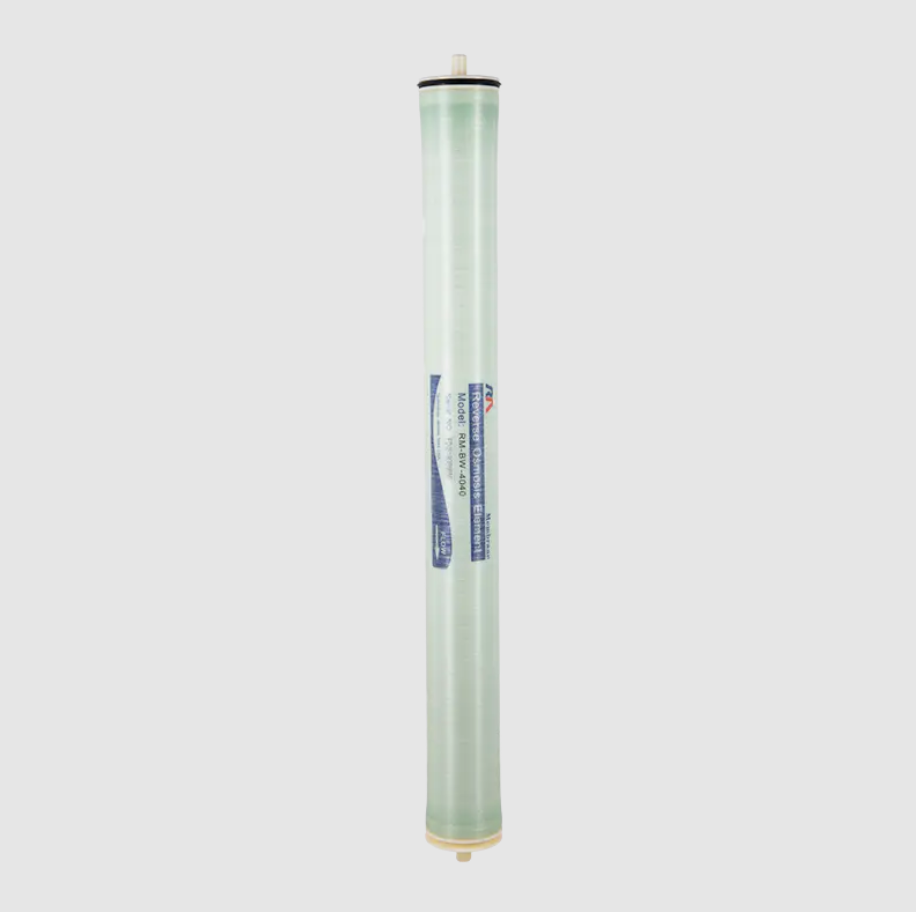
For projects that need a membrane designed for brackish-water desalination, Runmo offers BW series aromatic polyamide composite membrane elements. The series is designed for high water production and desalination performance, with removal of soluble salts, TOC, and SiO2.
The BW series is suitable for surface water, groundwater, tap water, and municipal water with salt content below 10,000 ppm. Typical uses include industrial pure water, boiler feed water, high-concentration saline wastewater treatment, beverage-water preparation, food processing, and pharmaceutical manufacturing.
For electronics and power industries, the membrane can be used where higher-purity water is required. The FR series uses a specially treated surface that changes membrane charge and smoothness while increasing hydrophilicity. This treatment is intended to reduce the attachment of pollutants and microorganisms and help control fouling.
What Buyers Should Review Before Selection
A membrane should be selected according to actual feed-water data. Buyers should compare salt content, flow demand, target permeate quality, system pressure, fouling risk, and cleaning conditions before making a decision.
Price matters, but it should be reviewed together with quality and delivery time. A lower purchase price may offer little value if the membrane does not match the water source or if delivery delays affect the project schedule.
Buyers should also ask about operating data, storage requirements, cleaning conditions, and replacement planning. Clear technical information helps engineering teams compare options and gives small business owners a clearer view of operating needs.
Matching Treatment to the Real Water Source
Agriculture, industry, and local water supply use brackish-water treatment for different reasons, but the selection logic is similar. Feed-water analysis, target quality, pretreatment, recovery, operating cost, and concentrate management should all be considered before the membrane system is finalized.
Runmo supplies membrane products for water-treatment applications and serves B2B customers such as engineering companies, small business owners, and water-treatment solution providers. Their BW membrane range is intended for brackish-water desalination and industrial water uses where quality, project timing, and practical operating needs matter.
For a new project or membrane replacement plan, contact them with feed-water data and target water requirements to discuss a suitable option.