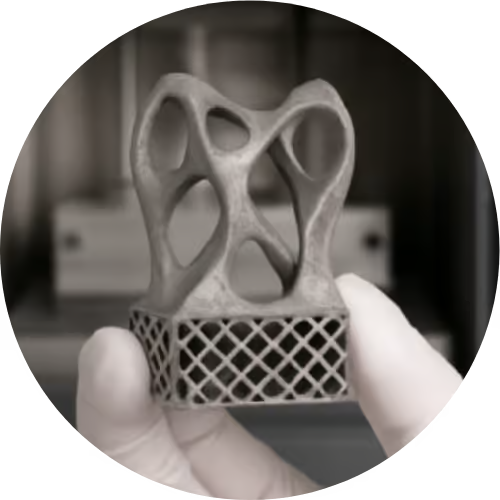
Metal additive manufacturing is useful for research involving complex metal geometries or printing process evaluation. Conventional machining may be more practical for simpler specimens, depending on the material and research objectives.
University laboratories should compare available technologies based on research goals, material requirements, equipment budgets, and workflow capacity.
Comparing Metal Additive Manufacturing Technologies
Laser powder bed fusion (LPBF), including selective laser melting (SLM), uses a laser to melt metal powder layer by layer. It can produce complex geometries, internal channels, and lattice structures, making it useful for studying how printing parameters affect part quality and mechanical properties.
Directed energy deposition (DED) offers a different approach. It feeds material into a focused energy source to build or repair components. This can suit research involving material deposition, surface modification, or larger parts, although its process characteristics differ from powder bed fusion.
Binder jetting is another technology worth evaluating when a project requires a different production workflow. It binds powder into a green part before subsequent processing, typically including debinding and sintering. The extra stages can affect dimensional accuracy, density, and final properties.
No single method is suitable for every laboratory. The choice should follow the experiment’s purpose, required material properties, geometric complexity, and available post-processing facilities.
Matching the Technology to Research Objectives
The first step is to define what the research needs to demonstrate. A laboratory investigating lightweight structures may prioritize lattice design, geometric freedom, and the relationship between structure and mechanical performance. A materials science team may focus on microstructure, porosity, thermal history, or the effect of process parameters on material properties.
For these projects, metal 3D printing technology should be assessed as part of an experimental method rather than simply as a way to produce components. Researchers need to know which process variables can be adjusted, what data can be recorded, and how specimens will be tested after printing.
It is also important to consider the repeatability of experiments. If a study compares several parameter settings, changing multiple variables at once can make the results difficult to interpret. Establishing a controlled baseline and documenting the material batch, build orientation, support strategy, and post-processing conditions can help researchers make more meaningful comparisons.
Evaluating Equipment Size and Material Compatibility
Build volume is a practical starting point when comparing machines. The usable space must accommodate the specimen, its orientation, support structures, and any additional parts planned for the same build. A larger build area may be useful for scaled components, while a compact system can be appropriate for small samples and early-stage prototypes.
LiMN 3D lists the LM-M150 with a build volume of 153 × 153 × 120 mm and a powder layer thickness range of 20–120 μm. Researchers should check whether the usable build space accommodates their specimens, orientations, and support structures. These specifications provide a starting point for equipment selection, but actual results also depend on material, geometry, and process conditions.
Material compatibility requires equal attention. Stainless steel, titanium alloys, cobalt-chromium alloys, and nickel-based superalloys may support different research questions, but each material has its own processing requirements and performance characteristics. Laboratories should confirm which powders are supported, whether validated parameter sets are available, and how material properties can be tested after printing.
The wider equipment setup matters, too. Powder handling, ventilation, protective gas, post-processing, inspection tools, operator training, and safety procedures all influence whether a laboratory can operate the system effectively. These requirements should be considered alongside the purchase price.
Considering Metal Additive Manufacturing Solutions Beyond Equipment
Buying a printer is not always the most practical first step. Laboratories with occasional printing needs may benefit from external printing services, especially when a project is still evaluating feasibility or requires materials and equipment not available on campus. Outsourcing can also help teams produce initial specimens before committing to a dedicated system.
A research group planning frequent experiments may find in-house printing more suitable. Direct access to equipment can make it easier to test parameter changes, coordinate builds with other experiments, and develop internal process knowledge. However, the total cost includes more than the machine itself. Powder, maintenance, staff time, post-processing, and testing should also be included in budget planning.
When evaluating metal additive manufacturing solutions, universities should consider material availability, documentation, training, maintenance, and technical support. Equipment and software should also provide sufficient process access to ensure research reproducibility and support method development.
Planning for Repeatable and Useful Experiments
Research value depends on more than producing a successful part. Laboratories need a plan for evaluating results and recording the conditions that produced them. Depending on the study, this may involve dimensional inspection, surface analysis, density measurement, microscopy, or mechanical testing.
Before choosing a machine or service provider, researchers should establish acceptance criteria for their specimens. These might include dimensional tolerances, surface finish, density, tensile performance, or the ability to produce a particular geometry. Clear criteria make it easier to compare printing methods and determine whether the equipment meets the study’s requirements.
Training and technical support should also be considered. Students and researchers may need guidance on build preparation, support design, powder handling, machine operation, and troubleshooting. Access to suitable training can help a laboratory develop consistent procedures as team members and research projects change.
Building a Research Capability That Fits the Lab
The most suitable metal printing setup is the one that aligns with the laboratory’s research questions, available expertise, and long-term plans. Comparing process capabilities, materials, build volume, operating requirements, and support options can help universities avoid selecting equipment based on specifications alone.
For laboratories exploring in-house metal printing or external development support, LiMN 3D provides information about its metal additive manufacturing equipment and research-related applications. The final decision should remain grounded in the laboratory’s experimental needs and the evidence required to validate its results.