Sailing through rough coastal waters subjects vessel structures to continuous rolling and pitching forces that disrupt internal fluid behaviors. Managing thermodynamic loops below deck requires specialized engineering to prevent liquid refrigerant from pooling incorrectly inside vital heat exchangers. Operating a dependable 12 volt DC marine air conditioner depends heavily on understanding how dynamic vessel movement alters internal pressure and mass flow distribution.
The Physics of Vessel Roll and Pitch on Closed Loops
Ocean waves create constant tilting motions that alter gravitational vectors relative to horizontal system layouts installed within hulls. When a watercraft pitches or rolls sharply, fluid within refrigerant lines and accumulator tanks shifts violently from side to side. This shifting mass changes the effective liquid head pressure acting upon internal expansion valves and compressor inlets. Stable thermal performance requires internal geometries designed to counteract sudden gravitational shifts during rough passages.
Accumulator Tank Design and Slosh Mitigation Baffles
Refrigerant accumulators capture excess liquid before it can enter the compressor suction port, protecting internal mechanical components from hydraulic shock. Internal baffles and perforated mesh screens inside the tank disrupt fluid momentum during severe wave action, preventing aggressive sloshing. Controlling fluid turbulence inside the reservoir maintains a steady gas-vapor separation process regardless of hull angle. Proper baffling keeps the compressor operating safely under heavy rolling conditions.
Refrigerant Mass Flow and Electronic Expansion Valves
Traditional mechanical thermal expansion valves struggle to maintain precise refrigerant superheat when system pressures fluctuate rapidly due to vessel motion. Modern electronic expansion valves utilize microprocessors to adjust orifice openings dynamically in response to real-time temperature sensors. This rapid digital compensation stabilizes mass flow rates across the evaporator coil despite shifting liquid levels. Precise metering prevents starvation or flooding of the cooling circuit during heavy weather.
Low-Voltage Architecture in Compact Power Grids
Auxiliary battery banks and solar charging arrays supply direct electrical energy to domestic appliances on modern cruising sailboats and trailerable motor yachts. Integrating a 12 volt DC marine air conditioner directly into a low-voltage power grid eliminates heavy inverter conversion losses. Lower electrical overhead stretches available battery capacity during quiet overnight anchorages without requiring constant generator runtime. Direct power utilization streamlines overall energy management below deck.
Variable-Frequency Modulation and Current Smoothing
Fixed-speed compressors draw massive electrical surge currents upon startup, placing severe loads on local battery banks and auxiliary wiring harnesses. Inverter-driven architecture modulates compressor motor speeds gradually, eliminating brutal power spikes and erratic thermal swings. Smooth motor operation draws minimal electrical current once the cabin reaches the desired thermal setpoint. Controlled power transitions safeguard delicate onboard electronics from voltage sags.
Metallurgy and Corrosion Resistance in Saline Atmospheres
High atmospheric humidity and airborne salt crystals relentlessly attack exposed metallic surfaces, causing premature oxidation across standard heat exchangers. Premium aquatic climate equipment relies heavily on marine-grade alloys, such as 304 stainless steel housings paired with specialized electrophoretic protective coatings. These robust materials resist pitting and corrosion even when drawing raw seawater directly through internal condenser loops. Protecting internal plumbing prevents sudden refrigerant leaks far away from port facilities.
Acoustic Engineering and Noise Minimization Below Deck
Continuous mechanical humming can quickly exhaust passengers and crew during long offshore passages or quiet overnight stays. Advanced acoustic engineering focuses on dampening compressor harmonics and optimizing airflow paths inside compact enclosures. Sound-insulating materials encase core components to significantly reduce operating decibel output without hindering thermal transfer. Quiet background operation allows sailors to rest comfortably without auditory fatigue.
Intelligent Remote Connectivity and System Diagnostics
Modern marine engineering incorporates smart digital controls that let operators monitor system parameters remotely via mobile applications from anywhere on board. Built-in WiFi modules allow crew members to adjust temperature thresholds, check pump operations, or review error codes without leaving the helm. Automated fault detection alerts operators to potential water flow restrictions or filter blockages before minor issues escalate. Integrating advanced digital controls streamlines daily climate management below deck.
Practical Implementation: The MAR-12V/09BP Performance Profile
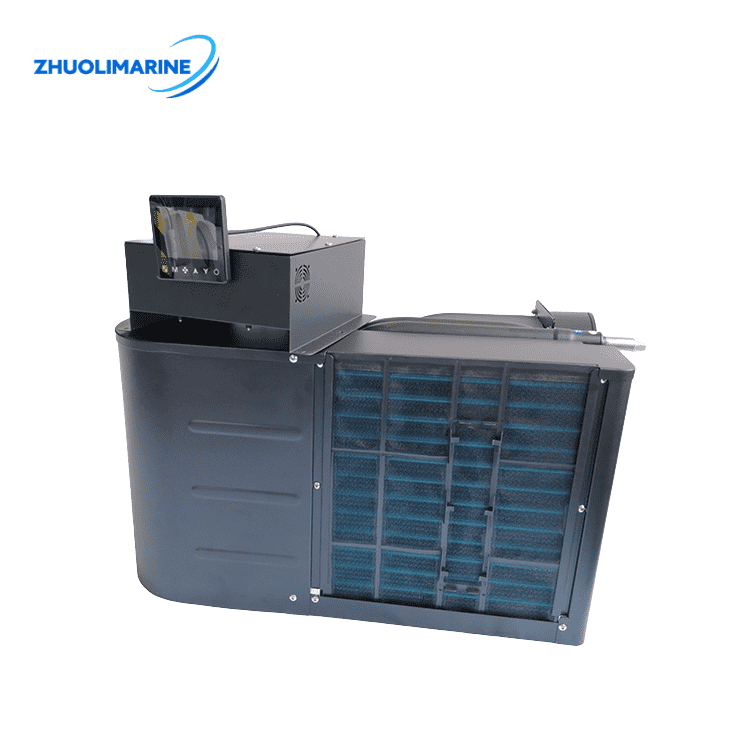
Modern climate engineering combines robust heating and cooling capabilities with advanced low-voltage electrical compatibility in compact self-contained footprints. For instance, the ZhuoliMarine 12V DC variable-frequency unit (MAR-12V/09BP) provides stable temperature control for boats and yachts while drawing minimal energy. Operating on a 12V DC architecture, this hardware integrates smoothly with modern lithium storage and solar arrays. Advanced anti-corrosion housing, electronic expansion valves, and quiet operational design ensure dependable performance under harsh marine conditions.
Conclusion
Maintaining reliable cabin comfort on a moving vessel requires careful attention to fluid dynamics, electronic metering, and material resilience. Prioritizing robust engineering safeguards structural investments against premature wear while expanding offshore cruising capabilities.
About ZhuoliMarine
ZhuoliMarine delivers rugged, motion-adaptive marine air conditioning systems optimized for dynamic offshore fluid conditions and low-voltage 12V DC vessel power systems. The MAR-12V/09BP variable-frequency unit features precision refrigerant control, anti-corrosion build and ultra-quiet operation to sustain stable cabin climate during rough sailing and continuous hull movement. Global industry partners are welcome to inquire about product specs, wholesale cooperation and professional OEM customization services.